The universe as we know it.

wayn3, do we have any empirical evidence for the existence of a multiverse?


any knowledge worth having must be acquired by personal effort


your mentality is demonstrative of the entire western world: let someone else do all the work and research for you

if people had to wait for someone else to release "empirical research" regarding something before acting on their own, then we'd be NOWHERE

(this isn't regarding the existence or nonexistence of a multiverse, but rather a general look on armchair skepticism)


but on that note, if you can't accept a multiverse, then by definition you are a determinist or randomist (lol)

and if you're a determinist , i laugh in your general direction if you think the universe as it is, is all that could be

randomists, well, im sure random is holding your brain together, faggot

inb4 citations needed
 
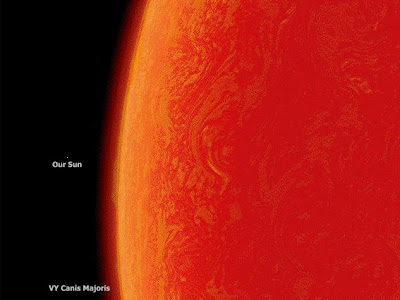
I get tripped out there's a sun as big as our solar system out there.

Scale to our sun below. Maybe one day we can take a cruise around it.

vy_canis_majoris.preview.jpg


canismajoriszanovustranu.jpg
 
Heres a question for you:

Assuming two space ships, 1 light year apart. Both travelling at a speed close to the speed of light. Lets say 99% of the speed of light, in the same direction (this is a difficult statement to make, because the concept of direction as we know it really only holds under certain conditions). The space ship that is "behind" fires a laser, because theyve got some beef. Laser is light. How long does it take for the laser to reach the other space ship? You dont need a calculator to answer this question.

Knowing the answer to question one, how long would it take for a laser fired by the space ship in front to reach the other one?


Laser beam ran into spontaneous black hole that disappeared shortly after allowing both ships to pass safely.

Prove me wrong motherfucker.

:bowdown::bowdown:
 
If you want to see a good star comparison you can check out these youtube vids
[ame=http://www.youtube.com/watch?v=g4iD-9GSW-0]Largest star ever discovered, compared to our Sun - YouTube[/ame]

and this one
[ame=http://www.youtube.com/watch?v=HEheh1BH34Q]Star Size Comparison HD - YouTube[/ame]
They really make you see how small the earth is compared to the universe we live in
 
wasnt that hard? Contains a slight mistake though. The speed of light is not relative. Everything else is relative. The speed of light is a constant.

I don't see how the answer is 1 instead of 100, so wany3, would you mind explaining why my reasoning is wrong real quick?

If you have two ships going at 99% of the speed of light and one fires laser, the photons shoot out at 100% (obviously). The first ships keeps moving at 99% of the speed of light, so you need to see where the photon and the ship intersect on a one-dimensional linear axis, as they're going in a straight line. So you'd do:

1 + .99x = x

Where 1 is the 1 light year head start the ship has, .99 is the length in lightyears the ship travels in a year, and x is the number of years (so the right side should be thought of as 1x, as the laser is going 1 lightyear/year, at the speed of light). Then you'd just solve it easily and get x=100.

Or to think of it in a different way, the laser would reach where the target ship was at the very moment it was fired in 1 year. However, since the ships are still moving, the ship would be .99 lightyear further at that point... so that would cyclically repeat by subtracting .01 each time until the difference finally reaches 0, which would take 100 years.

To get the answer of 1, you'd have to be thinking in terms of the two ships as the frame of reference, as if they weren't moving, and the photon moving between them. If this was shooting a cannonball or something I'd see it would be 1 year, as the ball's speed could increase to the speed of the ship + the speed gained by being shot out. However, in this case, for the answer to be 1 year, wouldn't the laser have to be going at the speed of light relative to the two ships PLUS the speed of light that lets it travel the distance in one year, so really 1.99 the speed of light? Which obviously isn't possible as the light always travels at the same speed...